
Weekly Market Update: Oil Prices Fall as Inflation and Rate Risks Persist (2 June 2026)
- Mutual Limited

- Jun 1
- 6 min read
“I may be only a fish and chip shop lady, but some of these economists need to get their heads out of the textbooks and get a job in the real world. I would not even let one of them handle my grocery shopping..”
Pauline Hanson
Cartoon of the Week

Source: www.heraldsun.com.au
Funds Snapshot

Movers & Shakers (week ending 29th May):
Stocks (ASX 200 ↑0.86%, S&P 500 ↑1.43%, NASDAQ (↑2.39%)
Bond Yields (ACGB3Y 4.50%, ↓4 bps / ACGB10Y 4.86%, ↓6 bps)
Bond Curves (A$ 3s10s +36 bps, ↑2 bp)
Credit Spreads (Major Bank 5Y Senior +69 bps, ↔ / Tier 2 +127 bps ↔)
Oil (Brent US$92.97/bbl, ↓10.21%)
Gold (US$4,538/oz, ↑0.64%)
State of Play
The dominant market narrative over the past week was still the tension between geopolitical de-escalation hopes and inflation persistence risks. Markets have increasingly traded on the assumption that the worst-case Middle East energy shock may be behind us, but investors remain highly sensitive to oil prices, inflation expectations and the implications for central bank policy.
The most important macro driver remains the evolving negotiations between the US and Iran regarding a ceasefire framework and the gradual reopening of the Strait of Hormuz (still pending). Earlier in the week, reports suggesting progress towards a draft agreement triggered a sharp fall in oil prices into the low-to-mid $90/bbl range as markets priced in improved energy supply expectations. However, optimism was quickly tempered by renewed military actions and ongoing disagreements over key conditions within the proposed framework. Fresh US strikes on Iranian targets late in the week reminded investors that a durable peace agreement remains uncertain.
The second major narrative has been the ongoing debate around whether the US economy is slowing enough to allow the Fed to ease policy later this year. Recent data has delivered a mixed message. Manufacturing activity remains expansionary, and labour market conditions remain broadly resilient, although markets are increasingly focused on signs of gradual cooling in employment growth. Consensus expectations for upcoming payrolls remain modest. Meanwhile, inflation remains problematic.
For markets, the key takeaway is growth has slowed enough to prevent fears of overheating, but inflation has not slowed enough to provide confidence that aggressive Fed easing is imminent. This has kept Treasury yields relatively elevated and limited the extent of equity multiple expansion despite strong risk sentiment.
Australian markets continue to be driven by inflation and interest rate expectations rather than growth optimism. The RBA's latest forecasts remain uncomfortable. Headline inflation is expected to peak near 4.8% in mid-2026 and underlying inflation is forecast to remain above 3% until mid-2027. Meanwhile, consumer inflation expectations remain elevated. Retail spending data continues to signal a weak consumer backdrop, reflecting the pressure of higher interest rates and cost-of-living challenges. And then, we have uncertainty stemming from the Federal budget.
This leaves Australia in a difficult position. Growth is sluggish (Q1 GDP data on Wednesday). Consumers remain under pressure and inflation remains too high. The result is a market that continues to price a relatively restrictive RBA compared with what many investors expected earlier in the year.
Equity Markets
Global equities have remained remarkably resilient. The prevailing market belief remains: the Middle East conflict will gradually de-escalate, global growth will slow but avoid recession, some central banks will eventually be able to ease policy, and corporate earnings remain sufficiently robust to support current valuations.
That narrative has allowed major equity indices to remain near record highs despite elevated oil prices and persistent geopolitical risks. The challenge is that valuations remain demanding, particularly in the US, leaving markets vulnerable if oil prices remain elevated for longer, inflation proves stickier than expected, peace negotiations break down, and / or labour markets weaken more abruptly.
The ASX 200 finished the week modestly higher, although trading conditions remained highly volatile and headline-driven. CPI printed a little lower than expected (headline), while the core figure was flat and still well-outside of RBA targets. Hikes remain a risk, which will weigh on household budgets, consumer spending, credit growth and sentiment broadly. Offshore, particularly US indices remain underpinned by AI optimism, with the S&P 500 and NASDAQ closing the week at new record highs.
Bond Markets
Bond yields again trended lower on peace hopes and ultimately easing inflationary tension (assuming oil prices continue to fall). Oil prices have fallen considerably from their war-peak, which was $118/bbl vs current prices (as I type) of $93/bbl. Current prices are 21% below post-war peaks, but remain 31% above pre-war levels, and the Strait of Hormuz remains effectively shut and peace negotiations clouded with uncertainty. Risks to inflation persist.
With persistent inflation risks, bond yields are still elevated vs where they were pre-war. Three-year bond yields are at or around 4.50% today, which is ↓33 bps below war peaks, but also ↑27 bps above pre-war levels and ↑116 bps higher than they were this time last year. For ten-year yields, we’re at 4.86%, ↓26 bps below war-peaks and ↑22 bps above pre-war levels. Over the past year, yields are ↑60 bps higher.
For the RBA, the policy outlook remains difficult. Markets increasingly accept that the Bank is unlikely to cut rates in the near term, with some economists still debating the possibility of additional tightening if inflation expectations deteriorate further or energy prices remain elevated. The RBA continues to emphasise that inflation risks remain skewed to the upside, particularly given geopolitical uncertainty and oil market disruption linked to the Strait of Hormuz conflict. Same as last week.
At this stage, one more hike is priced in (futures), most likely by around November, but it’s not a slam-dunk with only +20 bps priced in. Consensus is mixed, torn between one more hike and no more hikes.
Credit Markets
Once again, not a lot of new insights or nuggets of wisdom. Ditto last week and the week before that. These periods happen, where spreads remain moribund really, that is “completely lacking vitality and progress.” Spreads continue to grind sideways with monotonous consistency, trading in a relatively tight range.
Major bank senior spreads are hovering around the high 60 bps area for 5Y senior paper vs 71 bps for the past two primary deals done over the past couple of weeks. Tier 2 paper is steady at mid-to-high 120 bps, flat’ish on the week. Same commentary as last week with little movement in either direction. WBC priced a 3Y with 66 bps initial guidance – in line with the prior major bank 3Y senior. A strong book (~$5.4bn) saw final pricing tighten into 60 bps (vs 61 bps for the prior deal), with $3bn printed.
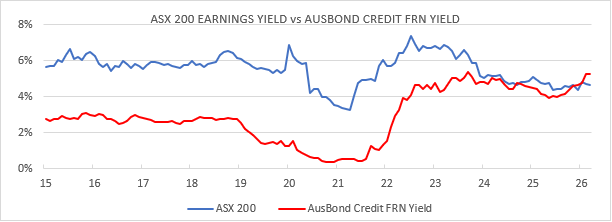
With the nascent improvement in the ASX 200 – albeit lagging its US peers – it’s worth looking again at the yield relatives between stocks and credit. Earnings yield on the ASX 200 is inside the yield offering on floating rate notes (AusBond Credit Floating Rate Note Index). Floating rate notes are offering a 61 bp yield premium to the ASX 200 (5.26% vs 4.65%), a historically rare dynamic. The ASX 200 has offered 260 bps more yield – on average historically – than floating notes (see chart below). This suggests either the ASX 200 needs to correct considerably, or floating rate note spreads need to compress.
Currency & Commodities
Oil prices remained highly sensitive to developments in US–Iran peace negotiations. Early optimism surrounding a potential ceasefire and reopening of the Strait of Hormuz saw Brent fall sharply as investors reduced geopolitical risk premiums. However, progress towards a lasting agreement remains uncertain. Renewed military activity and conflicting signals from both sides led to a partial recovery in oil prices later in the week, highlighting the market's continued sensitivity to supply disruption risks.
The key narrative has shifted from immediate supply loss concerns towards how quickly global energy markets can normalise. Even with a peace agreement, shipping, insurance and inventory rebuilding could keep a structural risk premium embedded in oil prices for some time.
Gold traded largely sideways over the week, caught between geopolitical uncertainty and higher bond yields. While ongoing Middle East tensions supported safe-haven demand, elevated real yields and a firmer US dollar limited upside momentum.
The market increasingly views gold as a hedge against longer-term inflation, fiscal and geopolitical risks rather than simply a short-term crisis asset. The key driver remains interest rate expectations. Sticky inflation data in the US reduced expectations for near-term Federal Reserve easing, placing upward pressure on yields and preventing a stronger rally in gold prices. Overall, gold consolidated recent gains, with investors balancing geopolitical risks against the prospect of higher-for-longer interest rates.


